Detailed Rules
The full rulebook for Atlas Conquest, from the basics of a turn to territory, battle, abilities, keywords, commanders, and setting up a game.
Atlas Conquest is a two-player competitive card battler played on a hex-grid board. This page starts with the basics and adds detail as it goes, so you can stop reading whenever you’re ready to play.
Overview
Each player leads an army with a commander. Your goal is to reduce the enemy commander’s  Health to 0 before they do the same to you.
Players take turns. On your turn you can:
- Play cards from your hand, paying for them with mana.
- Move your characters around the map.
- Battle enemy characters.
- Claim tiles with your commander to grow your territory, and with it your mana.
The rest of this page explains each of these.
The Map
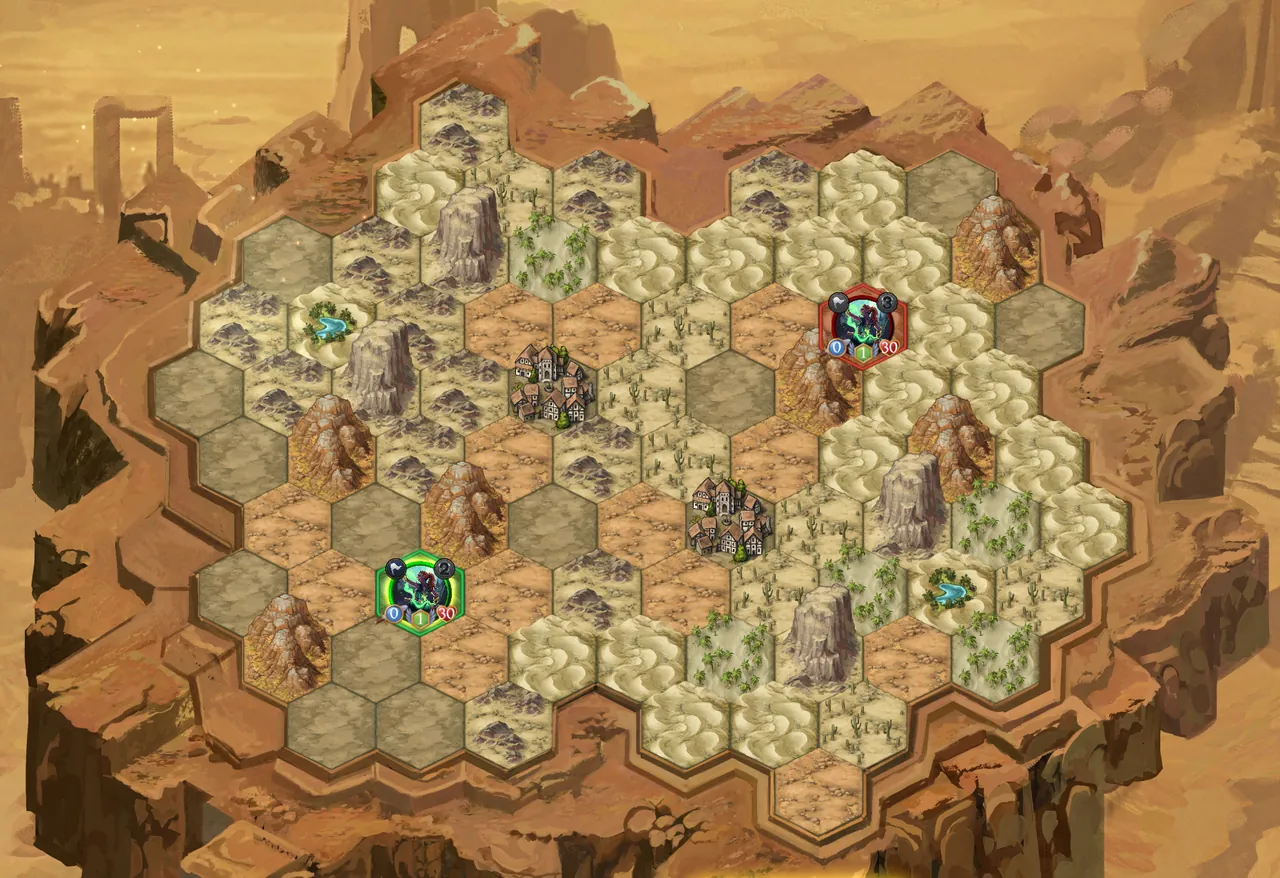
Each player’s territory is the tiles they own: yours is outlined in green, your opponent’s in red. A game starts with each commander on its starting tile, which is the only tile its player owns.

The map has three kinds of tile. Everything else, like desert, snow, or jungle, is just scenery.
- Normal tiles give
 each turn while you own them.
 - Villages give
 each turn while you own them.
 - Mountains can only be entered by characters with Flying.
Each game is played on one of three maps: Dunes (above), Snowmelt, and Tropics.


Mana and Cards
At the start of each of your turns, you draw a card and your mana refills to what your territory gives. Mana you don’t spend is lost when your turn ends. You begin the game owning a single tile, so claiming more land is how you afford bigger cards.
Every card costs mana to play. There are two kinds:
- Minions join the board as characters. Play one onto an empty tile in your territory. A minion can’t move or battle on the turn you play it.
- Spells have a one-time effect.

Characters
Commanders and minions are both characters. Characters stand on tiles, and each has three stats:
 Power: the damage it deals in battle.
 Speed: how many tiles it can move each turn.
- Health: the damage it can take before it’s destroyed.
Movement and Battle
Each turn, each of your characters can move up to its Speed in tiles. Drag it to where you want it to go.
 is dragged along a three-tile route. The tiles it can reach are outlined, and its Speed badge counts down to
  as it moves.
Characters can pass through tiles held by your other characters, but not through enemies, and must end their move on an empty tile.
To battle, drag a character onto an enemy next to it. Both deal damage equal to their Power to each other at the same time. A character whose Health reaches 0 is destroyed. If the defender is destroyed, the attacker moves into its tile.

 ) attacks a Guerilla Gorilla (
 ). Both deal damage at the same time: the Gorilla is destroyed, and the Cavalry, down to
  , moves into its tile.
A few more details:
- Each character can battle once per turn.
- Battling uses 1 movement, so a character needs at least 1 movement left to attack.
- Damage stays between turns. Characters don’t heal unless a card heals them.
- Commanders have no Power. They can’t start a battle and deal no damage when attacked, unless a card gives them Power.
Claiming Territory
Once per turn, your commander can claim the tile it’s standing on, if that tile is unclaimed and next to your territory. Claiming is free: it doesn’t use the commander’s movement or attack. A newly claimed tile starts giving mana at the start of your next turn.
Your territory can only grow as large as your commander’s  Dominion. When you reach that limit, you have to unclaim a tile before you can claim another: right-click a tile you own and choose to unclaim it. Right-clicking any tile also shows its details.
You can’t claim tiles your opponent owns, though some cards can.
Abilities
Some characters have abilities, shown as circles along the top of their token. Hover over one to read it. There are three kinds:
- Static abilities are always on, like Flying.
- Triggered abilities happen by themselves when something occurs. For example, an Arrival ability happens when its minion is played.
- Activated abilities are ones you choose to use: click the ability, or drag it onto a target.
Activated abilities sit in the top-left and top-right circles; static and triggered abilities sit in the top-center.
Reading Card Text
Hover over a card to see what each keyword in its text means.
Card text uses the stat icons in place of numbers. A number inside an icon is an amount of that stat: “Gain this turn” gives you 2 extra mana, and “Target minion gains +

 ” gives it +1 Power, +1 Speed, and +1 Health.
Common keywords:
- Arrival: happens when the card is played.
- Flying: can enter mountains.
- Haste: can move and battle on the turn it’s played.
- Trample: after destroying an enemy in battle, can battle again that turn.
- Deploy: can be played outside your territory.
- X-Deploy: can be played outside your territory, next to X. For example, Commander-Deploy means next to your commander.
- Legendary: you can’t play it while you control a copy of it.
- Range N: the effect reaches up to N tiles from its source. For spells, the source is your commander.
- Radius N: the effect hits everything within N tiles of its target.
- Cooldown N: after use, the ability can’t be used again for N of your turns.
Commanders
Your commander is on the board from the start, and when it falls, you lose.

Like other characters, commanders have Speed and Health. They also have two stats of their own:
- Dominion: the most tiles you can own at once.
 Intellect: your maximum hand size. If you have more cards than this when your turn ends, you choose which to discard.
Each commander also has its own text, with bonuses and abilities such as Claim.
Patrons
Every commander serves a patron god, shown by the color of the card. Your deck can only contain cards of your commander’s patron, plus neutral (beige) cards.
- Skaal (red): war. Strong, aggressive minions and destructive magic.
- Grenalia (green): nature. Mana growth, poisons, and big minions.
- Lucia (white): light. Unified armies, healing, and villages.
- Shadis (black): death. Relentless minions, powerful removal, and death synergies.
- Archaeon (blue): knowledge. Efficient card draw, spellcasters, and tempo plays.

Setting Up a Game
- Your deck has 40 to 60 cards, with no more than 3 copies of any card.
- The first player is chosen at random.
- Your opening hand: you look at as many cards as your commander’s Intellect and keep 3 if you’re going first, or 4 if you’re going second. The rest are shuffled back into your deck.
- Going second, you also get a War Chest: a free spell that gives you that turn and again at the start of your next turn.
How a Game Ends
You win when the enemy commander’s Health reaches 0. You also lose if you have to draw a card from an empty deck, or if you concede.
Keep reading
More from the Atlas
The Conquest Format
The Top 8 of the Atlas Conquest League is played in Conquest — three locked decks per player, win with all of them to take the round. Full rules, a worked example, and how to think about your lineup.

Atlas Conquest League Deck Choice
A guide to picking a deck for the Atlas Conquest league — upgrade paths from the starter decks, current top lists by archetype, and other notable builds worth a look.